
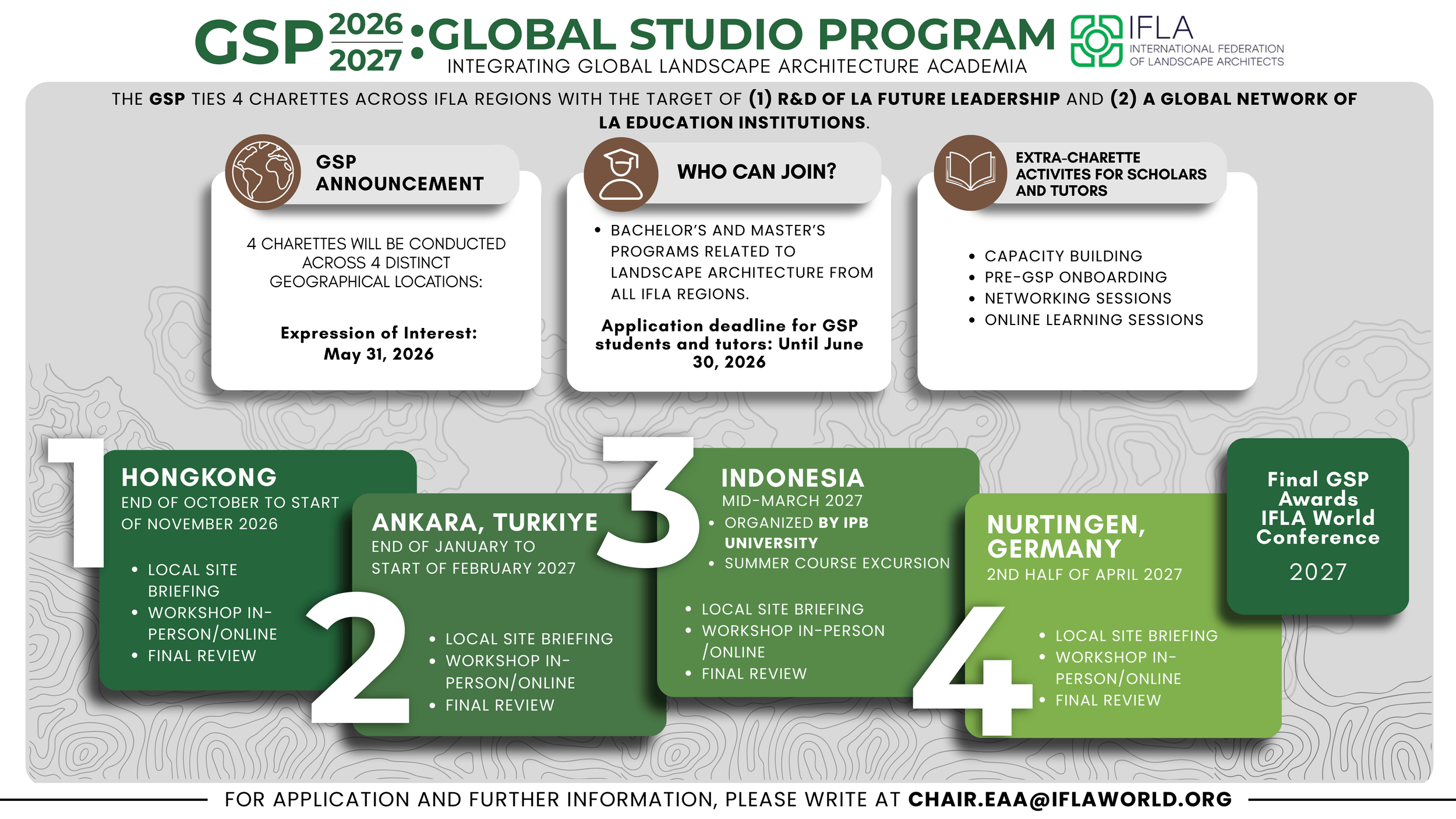
The IFLA GSP - Global Studio Program is an experimental attempt to solicit coordination across global students charettes in 2026 to 2027. The program offers a unique platform to integrate global landscape architecture academia through four international charettes.
Expression of Interest: May 31, 2026
Application Deadline: June 30, 2026
For further inquiries, you can reach out directly to CHAIR.EAA@IFLAWORLD.ORG.
Key objectives:
The participation of landscape architecture master’s or bachelor’s program across the IFLA geographic region or sub-region -I.e., North America, South America, Europe, Africa, Middle East, Asia Pacific Region- to each and every charette is the first and foremost target of the program. In particular, it is targeted the participation of 2 students and 1 tutor -selected among the full-time faculty members- per participating program.
Some form of coordination in terms of theme and format of each and every student charette is the secondary target of the program.
Rationale:
Following one of the core mandates of IFLA World, the rationale of the primary objective of is an actual global participation to the student charettes and renewed attractiveness of these for students and schools. In the mid-long term, hopefully, this should strengthen IFLA and increase IFLA’s reach in terms of students, academics, and institutional membership interests. The achievement of such target corresponds to the mission given by Bruno Marques -the incumbent IFLA World President- to the IFLA World EAA Chair.
The rationale of the secondary objective is to provide didactic meaning to the participation in all the charettes and trigger debate and communication between the major landscape events organizers so to diffuse knowledge of the regional differences and interests. This should later facilitate a complementary diversification of the events and thus the participation of the students in each and every charette. The much-needed debate that underpins the achievement of such a target is also meant to create knowledge between academics of different regions, thus building capacity in terms of networking, first of allstarting from the organizers of the various global events.
Basic structure:
With no intention of creating disruptions in the current organization of the events and charettes, if not desired by the organizers themselves, the GSP implies the following:
an alternative system of application for participating in the charettes -I.e., not by means of personal application, but through the program of enrolment- that complements the established systems of application;
the possibility to join all the charettes remotely, if not enough economic resources can be found by the students or the programs to support the logistic required by the participation to all the events.
the presence of tutors from the participating programs, that should act as coordinators for the students of their own program as well as mediators between the students and the teachers of the charette, when necessary.
Noteworthy to mention, each global event is allowed to enrol to a specific charette more students than those of the GSP. Anyhow, those of the GSP MUST participate to each and every charette. Indeed, the GSP can also be understood as anunique effort in building the Future Leadership in the field and imbue this with consideration for the global exchange.
As a recommendation, it is suggested that each and every charette organizers considers the following amount of participants as a reference: 30 students directly enrolled from the GSP, 20-30 local ones independently applying, 10-20 international ones independently applying for participating. The selection of those students independently applying and their possible rejections is handled by the organizers.
GSP Platform:
The current debate concerning the GSP is hold by a group of people, herein referred to as “GSP Platform” components, to which the individual charette organizers will be later added:
Alessandro Martinelli, IFLA World EAA Chair
Maria Bellalta, IFLA America EAA Chair
Madara Markova, IFLA Europe EAA Chair
Cecily Wanjiku Murage, IFLA Africa EAA Chair
Amer Habibullah, IFLA Middle East EAA Chair
Wenshan Huang, IFLA Asia Pacific Region EAA Chair
Through expressions of interest, the following Charettes have emerged as feasible components for the GSP:
Charette 1
23rd-27th of October 2026
- Hong Kong, China (coinciding with the IFLA World Congress 2026 on 28th to 30th October, 2026) – organized by the Hong Kong Institute of Landscape Architects with academic partners, Technological and Higher Education Institute of Hong Kong, The University of Hong Kong, and Hong Kong Design Institute.Charette 2
End of January to the first week of February 2027
- Ankara, Turkey - organized by Ankara University.Charette 3
Mid-March 2027
- Bogor, Indonesia - organized by Insititut Pertanian Bogor (IPB) UniversityCharette 4
2nd half of April 2027
- Nürtingen, Germany - organized by Hochschule für Wirtschaft und Umwelt Nürtingen-Geislingen
That said, the IFLA World EAA Chair strongly suggests that the regional Chairs ‘tap on the shoulders’ of possible participating programs while releasing the calls for participation.
Didactic system:
Originally, the GSP was reserved to bachelor’s students and related tutors. Anyhow, in 2026, the GSP is open to the higher education institutions that offer a master’s or a bachelor’s programs in landscape architecture. That said, the tutors must be full-time faculty members involved in aspects of design education.
In particular, landscape architecture programs are the entities that are actually applying to the GSP. The chair of the program has the duty to select those students and tutors that represent the program while they join the GSP. Anyhow, it is a decision reserved exclusively to the program if to support by financial means or less the participation of the students and tutors and if to apply for any form of governmental or non-governmental subsidy for the purpose. In any case, the IFLA World EAA Chair, as a key GSP promoter, will provide all necessary support to apply for such subsidies and therefore facilitate the participation of the students and tutors in the GSP.
GSP is based upon the participation of 2 students and 1 tutor from each of the participating programs to each charette included in the GSP. The students and tutor must join all the four charettes.
Due to the geographical setup of the GSP, the students and tutor have a chance to join in person one event at least without major financial burden. If financially and logistically feasible, the students and tutor are encouraged to participate in person in each charette. If that is not the case, remote participation by online videoconferencing is anyhow allowed in each and every charette. In this respect, a key duty of the tutor is to overview the work of the students and ensure their commitment to the charettes.
The topic and site of each charette is decided by the organization of the related event. That is, the GSP does not disrupt the autonomy of each event. Nonetheless, the IFLA World EAA Chair, as a key GSP promoter, encourages and structures a communication system between the organizers of the events. Indeed, on one hand, the desired target is a didactic linkage across the charettes.
The brief and preparatory materials of a charette must be supplied by the organizer of the related event. The implementation and coordination of the didactic activities of a charette is also a duty of the organizer.
Didactic goals:
As decided by each organizer, there may be one or several interim presentations of the design work during a charette. Anyhow, each and every charette must have a final presentation.
The organizers of a charette have the duty to assemble a panel that reviews and comments the presentations of the students. This panel may or may not include the tutors accompanying the students, according to the decision of the organizers. The panel and the teaching staff of each charette must provide to the World IFLA EAA Chair an evaluation of the GSP students in the form of a ranking.
Through this, the GSP students will confront socio-culturally diversified educators and approaches to the design. Most important, they will have a chance to realize the variety of currently operating design epistemologies. Thus, they will also have the chance to learn about the correlation between such variety and the socio-natural diversity within which the landscape architecture discipline is today operative.
For the students, this means that they can realize the cultural-professional diversity of the discipline around the world, and this can later help them to absorb the cultural gaps and direct their career in a global framework. Not only but also, since GSP is an institutional investment in building the Future Leadership in the field, this can help the students to develop personal relations with a large number of influential personalities in the field and across the IFLA regions, as well as structure a global network of peers.
Capacity-building goals for tutors and programs:
For the tutors, GSP is also expected to help them develop personal relations with a large number of influential personalities in the field and across the IFLA regions, as well as structure a global network of peers. This should immediately impact the possibility of contacting different academic realities, build operative networks, develop opportunities for career development, scientific research, and publishing, but also find inspiration for work and research.
Moreover, the exposure to different organizations of charette will offer the chance to learn different didactic methodologies, critically reflect on established teaching practices, and question the socio-cultural adequacy of the design teaching practice.
Finally, through the process of ranking and awarding the program with the best-performance students, official acknowledgement will be provided by IFLA World to the program in the form of a certificate; this may or may be not exhibited by the program to offer evidence of its global excellence but represents a first step for the program to achieve IFLA Education Recognition as evidence of teaching outcomes.
General goals:
As it can be understood through the previous sections, the GSP is fully adherent to the core mandates of IFLA. Indeed, it aims at critically challenging the idea that landscape architecture is a globally unified discipline. At the same time, it attempts at developing steps towards the construction of a culturally broader and more inclusive society of landscape architects. Indeed, only through concrete steps of social construction, such as those of the GSP, no matter how limited or partial, it is expected that opportune standards for the education, academia, and profession are developed in shared form and nurture global exchange.
Acknowledging the limitation of possible actions versus the extent of the general goals, the GSP intends to focus on two specific aspects: (1) research and development of Future Leadership in the field with respect of tutors and students, thus perspective practitioners and academics, and (2) the progressive establishment and expansion of a global network of higher education institutions, that might be called Global Landscape Academia and represent a future resource for capacity-building of the educators in the field.
Noteworthy, the Future Leadership and the Global Landscape Academia may be considered two interdependent aspects of a single goal. Indeed, without a proper environment, I.e., the Global Landscape Academia, it is difficult to nurture a progressive subject of operation, I.e., the Future Leadership in Landscape Architecture.