
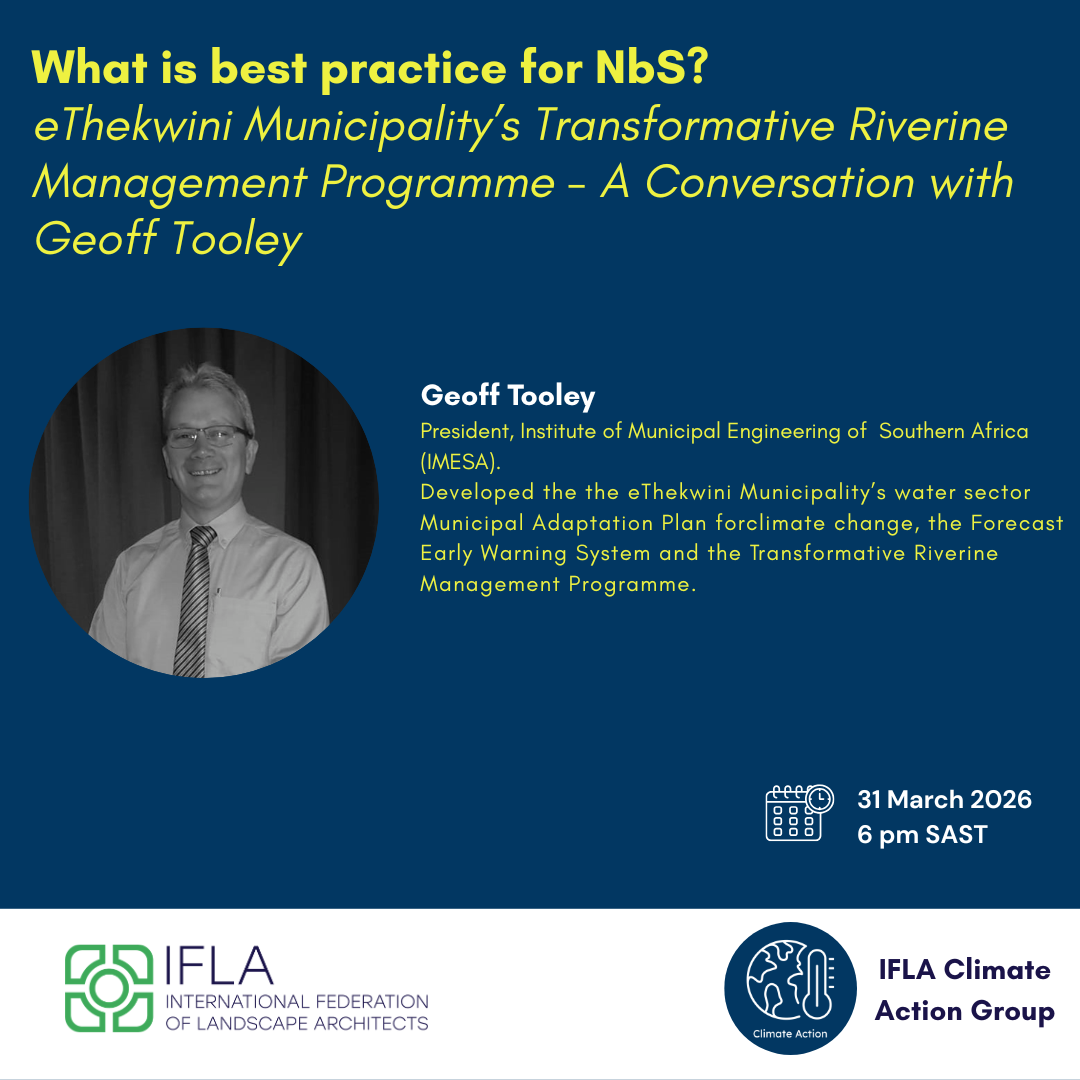
Curious about what really counts as “best practice” in disaster risk reduction? Join the conversation.
The 2025 G20 Disaster Risk Working group developed a Compendium of Case Studies on Ecosystems-Based Approaches for DRR and Nature-based-Solutions - including the eThekwini Municipality (South Africa) Transformative Riverine Management Programme (TRMP). Devastating floods post implementation might make this an odd selection for ‘best practice’.
Join Tamsin Faragher, Ruth Wairimu Muraguri, and Fatemeh Minabian in conversation with TRMP programme lead Geoff Tooley as they unpack the realities behind the case study.
Details:
📅 31st March
🎥 Live on Zoom
🔗 Register here: Zoom Webinar Link
This webinar builds off the IFLA CAG review of the G20 Disaster Risk Reduction – Nature-Based Solutions (NbS) Compendium of Case Studies.
Nature-Based Solutions: A Solution for Whose Problem?
The G20 Ecosystems-Based Approaches for Disaster Risk Reduction – Nature-Based Solutions (NbS) Compendium of Case Studies, released in support of the G20 Summit in Johannesburg, South Africa, is a historic first for Africa and marks a significant milestone. The Compendium highlights NbS as transformative tools for climate resilience, aligning with global frameworks such as the Sendai Framework, Paris Agreement, and Sustainable Development Goals (SDGs). Landscape architects, as stewards of nature-integrated design, strongly support this recognition.
Read more: G20 Compendium of NbS Case Studies PDF
The Role of the IFLA Climate Action Group
The International Federation of Landscape Architects (IFLA) Climate Action Group (CAG), comprising climate-resilient design specialists, acknowledges the Compendium’s value in building capacity and promoting policy advocacy. Landscape architects play a pivotal role in implementing NbS by designing with nature—leveraging plants, water, and ecological systems in both public and private spaces. Their work contributes to climate resilience by mitigating natural hazards, conserving resources, enhancing biodiversity, and reducing urban heat.
This integrated review offers a balanced critique, aiming to enrich NbS implementation through professional insights from practitioners working in South Africa, Iran, Kenya, Morocco, Canada, and Switzerland. They’ve drawn on their experience and made practical recommendations for scaling NbS globally, but especially in African and Global South contexts.
Are We Asking the Right Questions?
The integration of nature into urban environments is not new. Concepts like Garden Cities (1800), Copenhagen’s Finger Plan (1974), sustainable development, green infrastructure, and ecological infrastructure all share the principle of designing with nature. While NbS, formalized by the IUCN in 2009, may appear novel, it builds on these foundational ideas. The challenge lies not in conceptual novelty, but in implementation barriers—governance, financing, and professional integration.
Because landscape architects are the designers and implementors of NbS, we believe that we have a contribution to make to discussions related to our work that is grounded in landscape systems ecology, territorial hydrology, spatial justice, and process-based design.
The real question is:
Why are NbS-type projects not being widely implemented?
How can a deeper systemic, methodological, and socio-spatial analysis support implementation?
Read more here: Nature-Based Solutions: A Solution for Whose Problem PDF