
IFLA joins global partners in signing the Charter on Responsible Urbanisation at the UIA 2026 World Congress in Barcelona
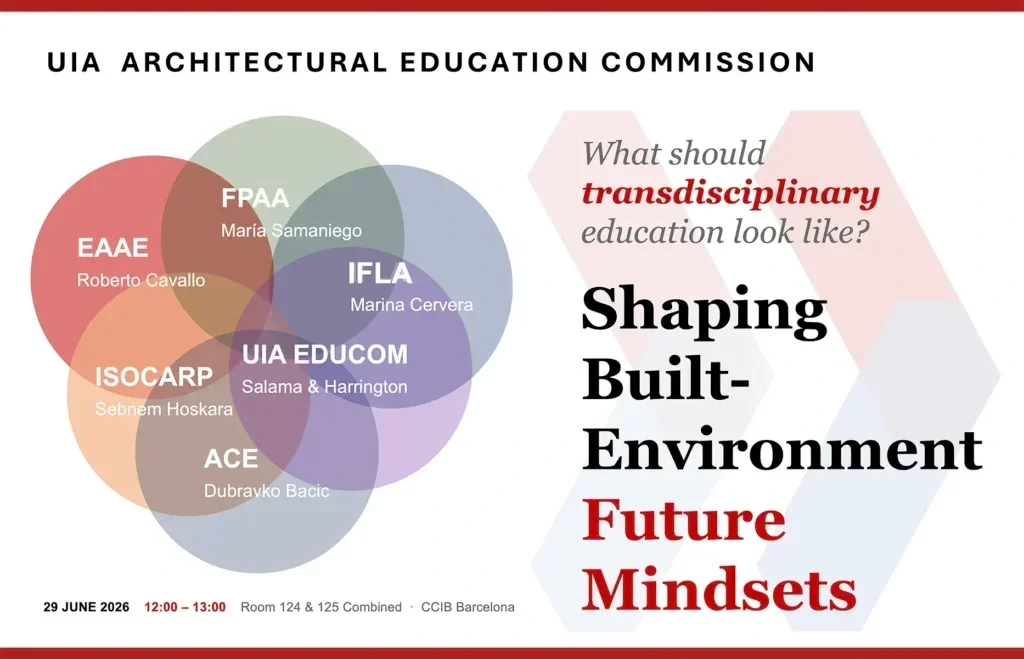
The International Federation of Landscape Architects co-signs Shaping Responsible Urban Environments and contributes to a transdisciplinary education session, reaffirming its partnership with the International Union of Architects.
Barcelona, 29 June 2026. The International Federation of Landscape Architects (IFLA) has joined UNESCO, UN-Habitat, the World Health Organization (WHO), the International Society of City and Regional Planners (ISOCARP), the International Union of Architects (UIA) and the City Council of Barcelona in signing Shaping Responsible Urban Environments: Towards a Charter on Urbanisation. The Charter is presented during the 2026 UNESCO-UIA World Capital of Architecture and the UIA World Congress of Architects, held in Barcelona from 28 June to 2 July 2026 under the theme "Becoming. Architectures for a planet in transition".
Developed within the framework of the UNESCO-UIA World Capital of Architecture Programme, the Charter sets out ten shared principles for responsible urbanisation. Rather than establishing a new agenda, it draws together commitments already held across the contributing organisations, translating professional expertise into clear, actionable messages for decision-makers, professionals and communities. With nearly 70 percent of humanity expected to live in cities by 2050, the Charter affirms urban landscapes and environments as a collective responsibility, and positions cities and territories as central spaces for advancing inclusive, resilient, heritage-sensitive, people-centred and sustainable futures.
Landscape architecture at the heart of the Charter
IFLA's contribution to the drafting was led by Jala Makhzoumi, landscape architect and past President of IFLA Middle East Region, working alongside Nadine Bitar, President of IFLA Middle East Region. Their work ensured that the perspective of landscape architecture is embedded throughout the document, recognising cities as living systems shaped over time by the interaction of natural, cultural, social and economic processes.
That perspective is most visible in the Charter's commitment to balance the relationship between cities and nature: protecting and restoring ecosystems; safeguarding biodiversity, soil and water; integrating green and blue infrastructure as foundational components of urban structure; and respecting the traditional land, water and ecological knowledge of local communities and Indigenous Peoples. These themes run alongside the Charter's principles on health and wellbeing, climate action and risk reduction, public space, heritage, participation and affordable housing.
"Responsible urbanisation is a shared obligation, not an option, and no single discipline can deliver it alone," said Bruno Marques, President of IFLA. "By signing this Charter, IFLA affirms that landscape is not a residual or decorative layer of the city but an essential infrastructure for resilience, health and social cohesion. We are proud that the voice of landscape architecture, shaped here under the leadership of Dr Jala Makhzoumi, sits alongside those of architecture, planning, heritage and health in a common commitment to the public interest."
A continuing partnership with the UIA
IFLA and the UIA were both founded in 1948 and share a long history of collaboration in service of the built and natural environments. IFLA represents 82 national and territorial member associations across five regions, IFLA Africa, IFLA Americas, IFLA Asia-Pacific, IFLA Europe and IFLA Middle East, and more than 100,000 landscape architects worldwide. Its participation in the Charter and across the Barcelona Congress reflects a sustained partnership with the UIA and with the wider family of built-environment organisations working alongside the United Nations system.
Shaping the future of built-environment education
As part of this partnership, IFLA also takes part in the transdisciplinary education session "Shaping Built-Environment Future Mindsets: What should transdisciplinary education look like?", convened by the UIA Architectural Education Commission (UIA EDUCOM) with Professor Ashraf M. Salama and Dr Selma Harrington. The session takes place on Monday 29 June 2026, from 12:00 to 13:00, in Rooms 124 and 125 at the CCIB.
The session brings together leading international education and professional bodies to ask how the next generation of built-environment professionals should be formed. IFLA is represented by our board member Marina Cervera (IFLA Treasurer), joined by colleagues from the European Association for Architectural Education (EAAE), the Pan-American Federation of Architects' Associations (FPAA), ISOCARP, the Architects' Council of Europe (ACE) and UIA EDUCOM. Together they explore how education across architecture, landscape architecture, planning and allied fields can move beyond disciplinary silos towards shared knowledge, cross-sectoral collaboration and a renewed sense of social responsibility.
Also during the Congress: Parlour Gardens
Running alongside the Congress, IFLA invites visitors to discover Parlour Gardens, an exhibition at the Jardí Botànic de Barcelona open from June to October 2026. The exhibition revisits the jardinets de saló, the miniature ceramic landscapes created in Barcelona in 1926 by architect Nicolau M. Rubió i Tudurí, ceramicist Llorenç Artigas and painter Raoul Dufy. A century on, thirteen of the world's leading landscape architects, among them Jala Makhzoumi, have been invited to reinvent the format, with their works scattered across the Botanical Garden to be discovered on foot. Follow the exhibition on Instagram at @parlour.gardens.